
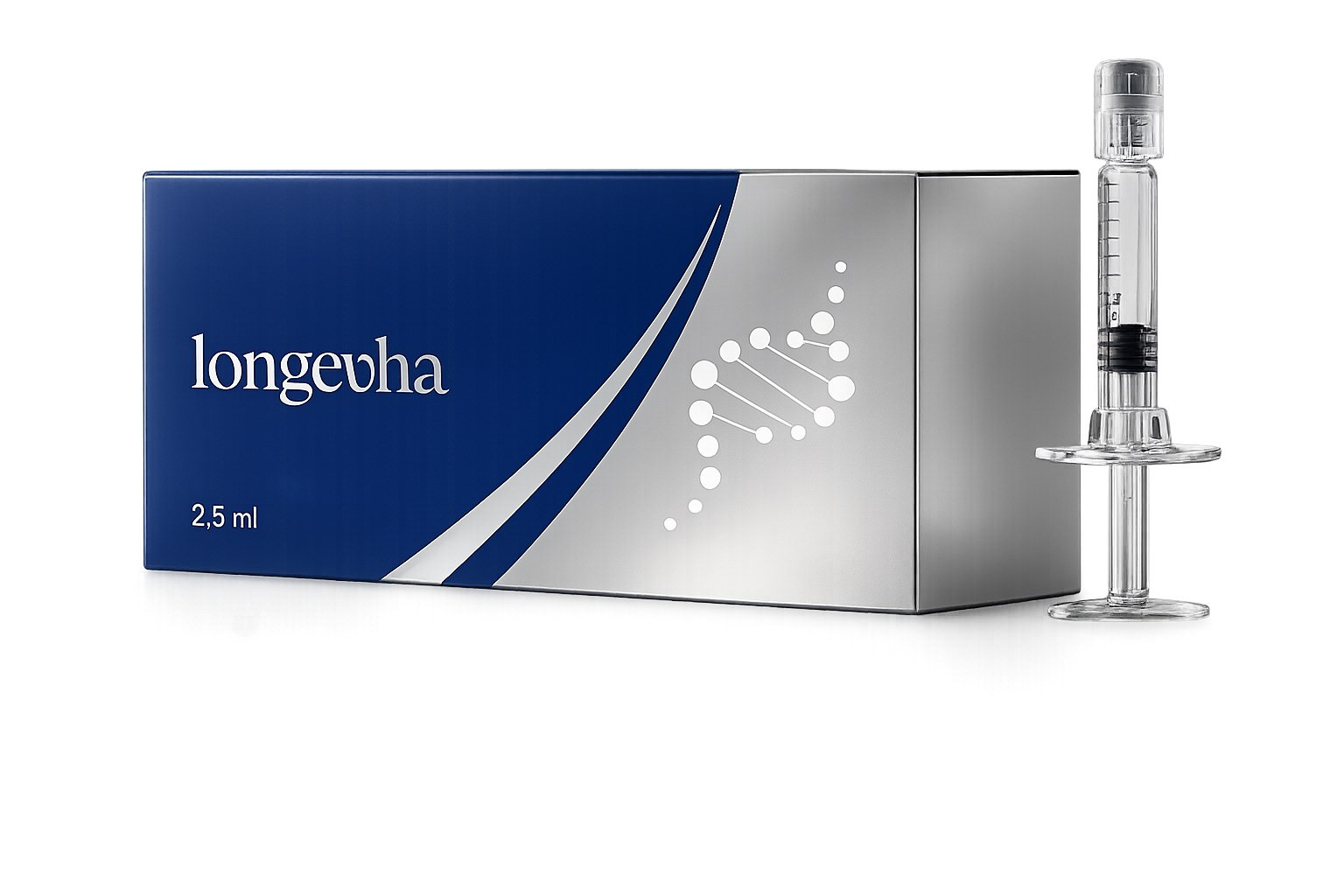
Not all hyaluronic acid works the same way. Two boosters can list “HA” on the label and behave completely differently once they’re in the skin. The difference comes down to molecular weight—and it’s the reason LongevHA’s dual-action matrix outperforms single-weight boosters. Here’s what that means, in plain terms, for both practitioners and the informed patients asking sharper questions.
What molecular weight actually means
Hyaluronic acid molecules come in different sizes. “Molecular weight” is simply a way of describing how large or small those molecules are—and size changes how they behave in the skin.
Think of it like sand and gravel. Both are made of the same material, but they fill space and settle differently. High and low molecular weight HA are the same molecule at different scales, each with a distinct job.
High molecular weight HA: surface hydration and glow
High molecular weight HA has large molecules that stay near the surface. They can’t travel deep, so they sit in the upper dermis and hold water where it’s most visible.
The result is immediate surface hydration, a smoother texture, and that fresh, dewy glow patients notice first. It also forms a hydrating layer that supports the skin’s outer barrier.
Low molecular weight HA: deeper support and signaling
Low molecular weight HA has smaller molecules that penetrate further into the dermis. They deliver moisture closer to the cells doing the real work of renewal and repair.
This deeper reach does more than hydrate. It supports the dermal environment where collagen production happens, contributing to plumpness and structure that build over time rather than fading in days.
Why single-weight boosters fall short
Most skin boosters on the market use one molecular weight. That means they solve one half of the equation.
A high-weight-only booster gives surface glow but limited depth. A low-weight-only booster supports the deeper dermis but skips that instant, visible hydration. Either way, the patient gets a partial result—and clinics get a treatment that’s hard to differentiate.
LongevHA’s 3.2% dual-action matrix
LongevHA combines both weights in a single formula: 32 mg/ml (3.2%) of dual-weight HA, 80 mg in total (40 mg high molecular weight and 40 mg low molecular weight)—a dual-action matrix that works at two depths at once.
- High molecular weight HA hydrates the upper dermis for immediate glow and barrier support
- Low molecular weight HA penetrates deeper for structural support and a primed environment for renewal
You’re not choosing between surface results and deeper support. You get both, from one treatment.
How it powers the Big 5
The dual-weight matrix does more than hydrate—it creates the ideal environment for LongevHA’s other actives to perform. Cellular repair needs a well-hydrated dermis to work efficiently.
- NAD+ recharges tired cells and activates the pathways behind renewal
- Resveratrol shields cells and supports those same repair processes
- Mannitol calms swelling and protects the HA from breaking down too quickly
- Peptides signal the skin to build fresh collagen
Together, the Big 5 target skin quality from the cellular level up—the science behind what Dr Adams Aesthetics calls the “time-reverse effect.”
The takeaway
Molecular weight isn’t a technicality—it’s the difference between hydrating skin and genuinely supporting it. LongevHA’s dual-action matrix covers both depths, then amplifies the result with a formula built to work in concert.
Want to experience the NAD+ difference? Visit longevha.co.uk or Dr Adams Aesthetics to locate a clinic near you.