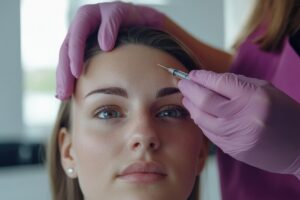

Autumn is one of the best times of year to start a skin booster course. Summer sun, heat and travel leave skin dehydrated and dull, lower UV levels make aftercare easier, and a course begun in October can be complete before the party season. LongevHA, a biorevitalising skin booster with dual-weight hyaluronic acid (32 mg/ml, 3.2%), NAD+, resveratrol, mannitol and peptides, is designed for exactly this kind of skin reset.
This guide explains what a skin booster course is, why timing matters more than most people expect, what the appointments involve, and how to plan yours so that your skin has settled well before December.
What is a skin booster course?
A skin booster course is a planned series of injectable treatments, given by a qualified practitioner, that aims to improve the quality of your skin rather than change the shape of your face. Instead of adding volume, a booster delivers hydration and active ingredients into the skin itself through a series of fine micro-injections, which is why the results are usually described as smoother, fresher and more radiant rather than “different”.
The word course matters. Skin quality is not something a single appointment is usually asked to deliver, so practitioners tend to recommend a plan: an initial treatment, follow-up sessions spaced out over several weeks, and then a maintenance interval. The number of sessions and the gap between them depend on your skin, your goals and your practitioner’s protocol, so there is no single answer, and anyone quoting you one without examining your skin should be asked how they arrived at it.
Why is autumn a good time to start?
Seasonal skin changes are real, and they line up well with the practical side of treatment. There are four reasons, and they reinforce each other.
Summer leaves its mark. By September, many people are noticing the cumulative effect of months of sun, heat, chlorine, salt water, air conditioning and travel. Skin often looks duller and feels drier, and fine lines can look more obvious than they did in spring. A booster course is aimed at exactly the hydration and skin-quality issues that tend to show up at this point, which is why practitioners often see an increase in consultations in the autumn.
Lower sun exposure makes aftercare simpler. After injectable treatments, practitioners usually advise protecting the skin from strong sun. With shorter days and weaker UV, following that advice in October is far easier than it is in July, when holidays, outdoor events and long evenings are all pulling the other way. Your practitioner will give you specific aftercare guidance for your treatment, and daily SPF remains important all year round.
Colder air and central heating test your skin barrier. Cold air outside and dry, heated air indoors draw moisture out of the skin, so skin that was already dehydrated in September often feels tighter and rougher by January. Starting a hydrating, cell-supporting course before winter means your skin is better prepared for the months when it works hardest to hold on to water.
Results can build before the party season. Because a course takes several weeks to complete, starting in October gives your skin time to respond and settle before the events in December. Leave it until late November and you are more likely to be booking against a deadline, which is when people tend to rush decisions they would otherwise take calmly.
The timeline below is an example only. Your practitioner sets the real intervals.
| When | What happens |
|---|---|
| Mid October | Book a consultation with a LongevHA practitioner |
| Late October | Assessment and first treatment |
| November | Follow-up sessions as your practitioner advises |
| December | Skin that has had time to settle before the festive season |
What makes LongevHA suited to a course?
LongevHA is not a standard hydration booster. Its “Big 5” formula is designed to support skin at the cellular level, and each ingredient has a different job.
The hyaluronic acid comes first. LongevHA contains 32 mg/ml (3.2%) of HA, made up of 40 mg of high molecular weight HA and 40 mg of low molecular weight HA, 80 mg in total. The high molecular weight HA supports surface hydration and glow, while the low molecular weight HA reaches deeper into the dermis. You can read more in our guide to high versus low molecular weight HA.
Around that hydration sit three active ingredients. NAD+ is a coenzyme found in every cell and is designed to support cellular energy and sirtuin activation. Resveratrol is an antioxidant that helps defend cells against oxidative stress, which is the kind of damage summer sun and pollution contribute to. Peptides signal the skin to support collagen and elastin. Together they target the tired, flat look that summer can leave behind, which is a different problem from simple dryness.
The fifth ingredient, mannitol, is there for the treatment experience. It helps protect the hyaluronic acid from premature breakdown and calms the skin’s response to injection, so that swelling is kept low. That matters for a course in particular, because a treatment that is easy to recover from is one that people are more likely to complete. Our article on why mannitol helps your glow last longer explains how it works.
What happens at your appointments?
Your first appointment is a consultation. A qualified practitioner will take a medical history, look at your skin in good light, ask what you want to change, and tell you whether a skin booster is the right treatment or whether something else would serve you better. If a booster is right, they will explain the plan, the number of sessions and the expected recovery before anything is injected.
The treatment itself is a series of fine micro-injections across the area being treated. LongevHA contains 0.3% lidocaine to support comfort during the injection. Some temporary redness, small bumps or swelling can follow any injectable treatment, and your practitioner will explain what to expect and for how long. Mannitol is included to help reduce post-injection swelling, which is designed to support a smoother recovery, but individual responses vary. Our treatment guide covers the areas treated and what to expect in more detail.
What results can you expect, and who is it suitable for?
Patients typically look for smoother texture, better hydration and a fresher, more radiant complexion rather than a visible change in facial shape. Following a practitioner-recommended plan, visible results from LongevHA typically last between 12 and 18 months, although this varies with age, metabolism, lifestyle and baseline skin health.
Skin boosters suit people whose main concerns are dullness, dehydration, fine lines or loss of radiance, and they are a common starting point for people new to injectables. They are not suitable for everyone. Your practitioner will take a full medical history and will tell you whether treatment is right for you. Injectables are generally not recommended during pregnancy or breastfeeding, over active skin infections, or if you are allergic to an ingredient.
How do you get started this autumn?
Start by finding a trained practitioner near you using our Find a Provider page. Book a consultation and go in with your concerns, your goals and any events you are planning for, because the date of an event helps your practitioner work backwards to a sensible schedule. Agree a plan, including the number of sessions, the spacing and the aftercare. Then follow your practitioner’s aftercare advice and use daily SPF, which protects the result as well as the skin.
A note for practitioners: October is a strong booking window. Patients are back from summer, thinking about the party season and open to treatments that improve skin quality, so a seasonal “autumn skin reset” course is an easy conversation to start. See the LongevHA skin booster overview for the formula and product details.
Autumn skin booster course: frequently asked questions
When is the best time of year to start a skin booster course?
Autumn is an excellent time. Lower UV exposure makes aftercare easier, skin is recovering from summer and a course started in October can be complete before December events. That said, a booster can be started at any time of year.
Is autumn better than summer for skin boosters?
For most people, autumn is more convenient because strong sun is easier to avoid after treatment. Your practitioner will advise on sun protection whatever the season.
How long before an event should I start my course?
Allow enough time for the full course and for your skin to settle. Your practitioner will plan the schedule around your event date.
Does LongevHA contain lidocaine?
Yes. LongevHA contains 0.3% lidocaine to support comfort during the injection.
Is there downtime after LongevHA?
Mannitol is included to help reduce post-injection swelling, which is designed to support a smoother recovery. Some temporary redness or swelling can still occur, and your practitioner will explain what to expect.
How long do skin booster results last?
With a practitioner-recommended plan, LongevHA results typically last 12 to 18 months, depending on individual factors.
Ready to reset your skin this autumn?
Find a LongevHA practitioner near you through our Find a Provider page, or read more about the LongevHA skin booster.